In the valley of Elah, under a sky smeared with tension, a shepherd boy dared to step between heaven and horror. He wasn’t armored in bronze or silver. He carried no sword, no shield, no fear.
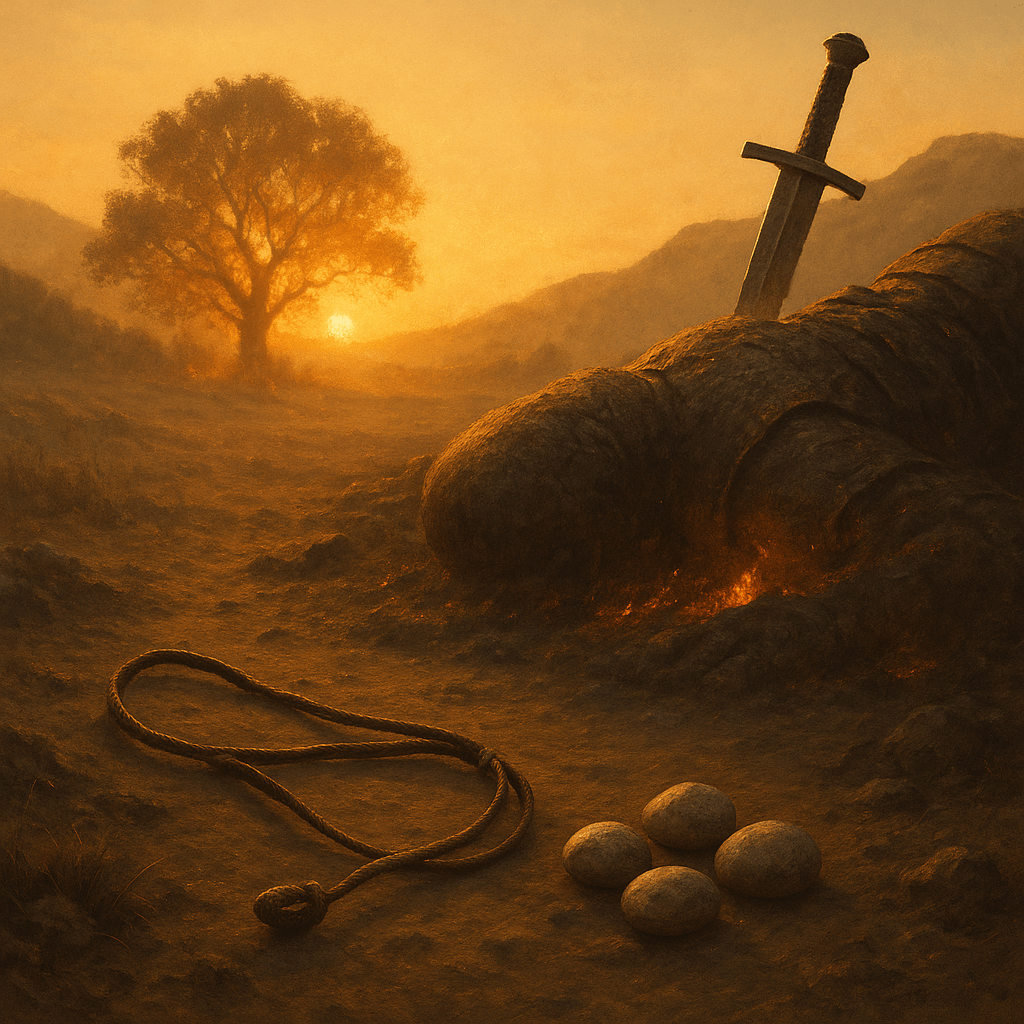
Only five smooth stones and the name of the Lord.
We know this as a story of David and Goliath. But beneath the surface—under the skin of the story—is a cosmic message woven through scripture, whispered through generations.
This was not merely a tale of a young man defeating a giant. It was a divine foreshadowing, a spiritual archetype, a war between two kingdoms—one carnal, one divine.
Let’s dig deeper into the true, underlying meaning.
The Valley of Decision
The battle takes place in the Valley of Elah—a name meaning “oak tree,” often symbolic in a scripture of strength, steadfastness, and sometimes idolatry (Isaiah 1:29, Hosea 4:13). This valley was not just a geographic location; it represented a spiritual crossroads.
Every one of us stands in our own Valley of Elah at some point in life. A moment where fear mocks faith. Where the voices of the world sound louder than the whisper of God.
Goliath shouted for 40 days—a number that biblically represents testing and purification (the flood, the wilderness, the fast of Christ). Forty days of intimidation were meant to sift the hearts of men. Not just to test Israel—but to reveal David.
Why Five Stones?
David chose five smooth stones (1 Samuel 17:40). He only needed one. So why five?
This wasn’t over-preparation or lack of faith.
2 Samuel 21:15-22 tells us that Goliath had four brothers. David came prepared not just to kill one giant—but to slay a bloodline of intimidation.
How often do we fight one battle, unaware that it’s connected to a generational stronghold?
David wasn’t just facing a man; he was facing a spiritual legacy of opposition of God’s people. And he came ready to end it all.
The Shepherd’s Heart: God’s Anointed Weapon
Before this battle, David was anointed king by Samuel but still went back to tend sheep. His family didn’t see the crown—they saw a boy with a harp.
But God saw a warrior formed in secret places, trained by lions and bears.
It echoes Psalm 144:1: “Blessed be the Lord, my rock, who trains my hands for war and my fingers for battle.”
David didn’t need armor because his confidence didn’t come from men—it came from intimacy with God.
His sling wasn’t just a weapon. It was the manifestation of a practiced, hidden obedience.
You don’t kill Goliath by becoming like him. You kill him by remaining who God made you to be.
The Sword of the Enemy Becomes the Victory of God
After Goliath falls, David does something shocking—he runs to the corpse and uses Goliath’s own sword to cut off his head (1 Samuel 17:51).
Why?
Because every giant that opposes God carries within it the instrument of its own destruction. What was once the weapon of fear becomes the trophy of faith.
Later, in 1 Samuel 21:9, we find out David retrieves Goliath’s sword and keeps it—“There is none like it,” he says.
The sword would become a reminder of God’s faithfulness, a testimony in David’s hand. Just as Christ used the cross—the enemy’s instrument of death—as the very means of redemption, David used the enemy’s weapon to solidify the victory.
A Shadow of the Greater David
David, the shepherd-king, slays the giant with faith and obedience. But this story foreshadows a deeper narrative:
- Jesus, the true Shepherd King, enters the valley of death not with armor, but with meekness and resolve.
- Goliath, towering in pride, is a picture of Satan’s dominion over humanity, rooted in fear and deception.
- The sling stone becomes a symbol of the cornerstone rejected by men, yet chosen by God (Psalm 118:22, 1 Peter 2:4-7).
- As David used the enemy’s weapon to cut off his head, so too did Christ trample death using death itself, defeating it through the very cross meant to destroy Him.
David’s victory didn’t just save Israel. It pointed to a coming Messiah who would save all of mankind—not by brute strength, but by courage of a heart fully surrendered to the will of the Father.
Scriptural Threads Intertwined
- Genesis 3:15– “He shall crush your head…” echoes prophetically in David crushing the head of Goliath.
- 1 Corinthians 1:27 – “God chose the weak things of the world to shame the strong.” David was weak in appearance, but mighty in Spirit.
- Isaiah 11:1 – “A shoot will come up from the stump of Jesse…” David, son of Jesse, becomes the root from which the Messiah is born.
- Revelation 19:15 – The Messiah comes wielding a sword from His mouth—the Word, just as David wielded the name of the Lord against Goliath.
Reflection: Who or What Is Your Goliath?
Goliath doesn’t always look like a 9-foot man. He often comes disguised as shame. As insecurity. As addiction. As silence in your prayer life. As fear of your calling.
The battle is not won with worldly weapons. It’s won in the quiet places with God, with stones smoothed by time and truth.
Goliath fell not because David was strong—but because God was with him.
And so it is with you.
When You Face the Giant…
Remember:
- You are not what others call you—you are who God anointed you to be in secret.
- Your preparation is not wasted—it’s prophetic.
- You enemy is already doomed—the victory has been decided.
- You fight from victory, not for it—because the Greater David has already won.
Let this be your reminder: giants still fall.
And when they do, they make the earth tremble not in fear—but in praise.


 Armored Ashes
Leave a comment